Legacy Fabrics
Grow Your Own Natural Dye/Fiber Seeds - Buffalo Seed Company
Grow Your Own Natural Dye/Fiber Seeds - Buffalo Seed Company
*Fabric is sold in 1/2 yard increments
Couldn't load pickup availability
Check out this wonderful selection of natural dye/fiber seeds from local seed company the Buffalo Seed Co!
Natural dyeing your fabric is not only much better for the environment and your health, but it is also SEW much fun! Getting access to fresh dye materials can be difficult, so why not grow your own! These flowers will not only be beautiful in your garden, but they'll also create some amazing colors and patterns on your garments! Read more about each type from the words of Buffalo Seed Co below!
All seeds are sold per pack, each type will have the exact quantity listed.
Japanese Indigo (Persicaria tinctoria): 50 seeds This is an easy plant to grow and the leaves can be used to make a deep blue fiber dye! I make blue dye!
GROWING INSTRUCTIONS—Direct seeded. After the last frost, sow 5-7 seeds 1/4" deep every 12" in rows 12" apart. Matures in 90 days
Flax Bulgarian (Linum usitatissimum L.): 100 seeds Flax is used for both food and fiber. The seeds are edible, and the fibers are used to make linen. This Bulgarian variety reaches several feet tall, displays beautiful flowers, and produces plentiful seed pods and seeds. The pollinators love it!
GROWING INSTRUCTIONS—Direct seeded. Sow outside in early spring. Sow three seeds 1/2" deep every 6" in rows 12" apart.
Sunflower Hopi Black Dye (Helianthus annuus): 25 seeds Our friend Gary Paul Nabhan collected this beautiful sunflower landrace at Third Mesa in Arizona in the late 1970’s. As the name suggests the blue-black achenes from this sunflower can be used to produce a brilliant dye. A landrace is a traditional variety with deep cultural roots that is often dynamic, diverse, and adapted to specific environmental conditions. I make blue/black dye!
GROWING INSTRUCTIONS—Direct seeded. After the last frost, sow three seeds 1/2" deep every 12" in rows 18" apart. Matures in 95 days to seed
Amaranth Red Garnet (Amaranthus sp.): 100 seeds This lovely red headed amaranth variety can reach six feet tall! Many grow it as an ornamental, but the seeds and leaves are edible. If you need some beauty in your life that is edible, then get this. We originally received seeds of this variety from Stacy Featherstone in Indiana. I make pink/red dye!
GROWING INSTRUCTION— Direct seeded. Prepare soil after the soil warms in late spring/early summer. Sprinkle 5-7 seeds on top of the soil every 8" and press into soil gently. Space rows 12" apart.
Coreopsis Dyers (Coreopsis tinctoria): 100 seeds This coreopsis has a range of color from reddish to yellow. As the name implies, it can be used as a dye. It will brighten up the garden and bring you a smile. I make yellow/orange/rusty red dye!
GROWING INSTRUCTIONS—Direct seeded. After the danger of last frost, sprinkle several seeds every 12” in rows 12” apart. Gently press the seeds in the soil as they need light to germinate.
Marigold OG (Tagetes patula): 50 seeds OG is what you think of when you think of marigold. This particular variety sizes up well, keeps pests away, can be sold as cut flowers, and will make you smile every time you see it. I make yellow/gold/orange dye!
GROWING INSTRUCTIONS—Direct seeded. After the last frost, sow three seeds 1/4" deep every 6" in rows 12" apart or scatter on top and rake seeds in. Flowers in 45 days
Cosmos Sonata (Cosmos bipinnatus): 25 seeds We support the diversity and the colors of this epic cosmos variety stands true to our support. The pinks, reds, whites, and purples bring smiles and inner peace to those who experience it. Get some and find out. You will be pleasantly surprised. Flowers can be used as cut flowers, for dye, and attract bees and butterflies in quantity. I make pink/light blue/lavender dye!
GROWING INSTRUCTIONS—Direct seeded. Sow seeds outside after the danger of last frost has passed. Sow three seeds every 12" in rows 12" apart. Flowers from July through first frost.
Cosmos Polidor (Cosmos sulphureus): 50 seeds This brilliant orange cosmos variety reached 4-5 feet tall when we grew it in Garnett, Kansas. Flowers can be used as cut flowers, for dye, and to attract bees and butterflies in quantity. I make yellow/orange dye!
GROWING INSTRUCTIONS—Direct seeded. Sow seeds outside after the danger of last frost has passed. Sow three seeds every 12" in rows 12" apart. Flowers from July through first frost
Rudbeckia Cherry Brandy (Rudbeckia hirta): 100 seeds First red Rudbeckia from seed. Reaches around 2 feet tall and sends up dozens of cherry-colored flowers. Flowers late into the fall. Photo by Sara Worcester. I make olive/yellow/orange dye!
GROWING INSTRUCTIONS—Direct seeded. Sow outside after the danger of frost has passed. Sow on top of soil and cover lightly with soil. Space 24" within rows and 24" between rows.
Calendula Mix (Calendula officinalis): 50 seeds This mix of calendula goodness jumped into our hands, pockets, and bags during our days in the one and only Wooster, Ohio. The flowers in this mix manifest themselves in numerous tones of yelling yellow. This is a great cut flower to sell at the market, bring inside to brighten up your day, or to give to that special someone as a sunshine pick-me-up. Word on the street is that it makes a powerful tincture that can assist in strengthening and healing the physical body against a number of ailments. Consult a physician before use. I make yellow dye!
GROWING INSTRUCTIONS—Direct seeded. Sow outside after the danger of last frost has passed. Sow three seeds 1/2" deep every 8" in rows 12" apart. Flowers in 45-60 days
Bachelor's Button Mix (Centaurea cyanus): 100 seeds This one is a gorgeous annual flower mix made up of blue, purple, pink, and white expressions. Grows great without field irrigation here in the Midwest. Plant in early spring through the beginning of summer. Positive vibrations flow with this beauty! I make muted purple/blue dye!
GROWING INSTRUCTIONS—Direct seeded. Sow outside after the danger of frost has passed. Sow three seeds 1/2" deep every 8" in rows 12" apart. Bloom in approximately 80 days.
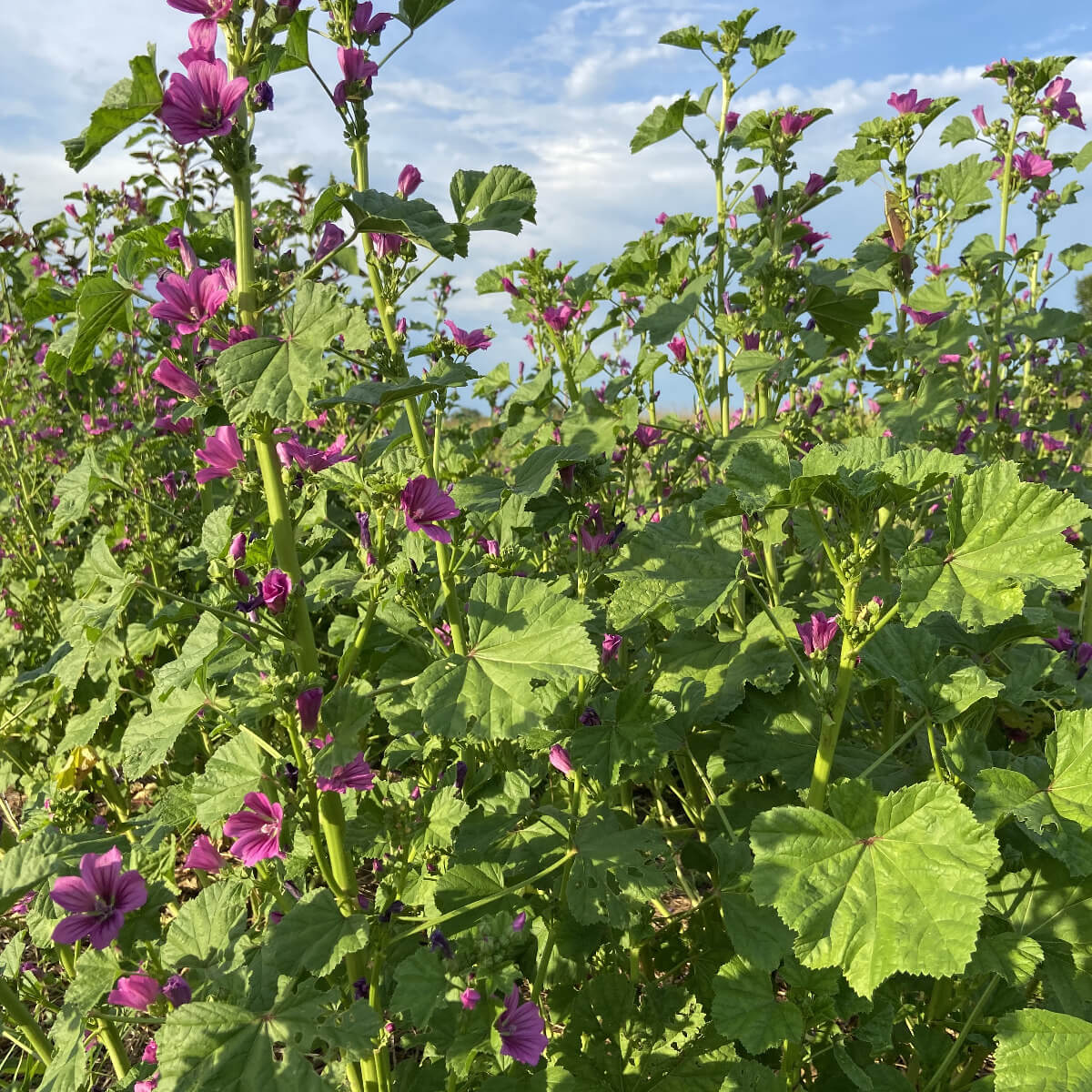
Malva Georgian (Malva sylvestris): 50 seeds Malva is a dynamic plant with many uses. It is a great ornamental, has edible leaves, and has been noted as having medicinal properties. This variety from the country Georgia can reach well over 4-5 feet tall and throws out gorgeous mauve flowers. I make yellow/green dye!
GROWING INSTRUCTIONS—Direct seeded. Seeds need a minimum soil temperature of 65F to emerge. Sow three seeds 1" deep every 24" in rows 24" apart.
Share